Mr Sadanand Shetty......

Mr Sadanand Shetty......
Sadanand Shetty...Founder OIOP

Tuesday, November 13, 2012

November 2012 issue


Gender Tilt
The last few decades have seen Indian women do exceedingly well for themselves in all walks of life. However, gender discrimination at home and workplace continue to exist despite the progress that we have made as a nation. Education and laws have not yet been able to bring the desired social change. Women are still battling issues such as female foeticide, sexual harassment, molestation, equality, domestic violence, regressive customs and attitudes, safety in public places, etc., all of which call for change in mindsets of people. While in urban areas, the awareness is greater and we can see a small change happening, it will be long before the change trickles down to villages. We have a number of laws to protect women from atrocities in society, but we need stricter implementation of these laws for a visible change. Gender sensitization of boys from an early age and making it mandatory for girls to learn martial arts in schools are two solutions that can probably tilt the bias in favour of women.

The November 2012 issue of One India One People looks into the gender bias prevalent in Indian society. Eminent women activists and researchers highlight the bias against women and offer solutions for social transformation.

The lead article ‘An unfair tilt’, as the title suggests focuses on gender discrimination. Ranjona Banerji, senior journalist and currently a consulting editor with the media website MxMIndia.com, writes that as long as institutions like the police and courts are ‘manned’ by those who find equal rights for women difficult to accept, gender discrimination in society will continue.

Crime of any kind flourishes when the perpetrators do not fear punishment or social ostracism. A look at the desultory police investigations into crimes against women and the resultant abysmal conviction rates brings home this point, writes Lina Mathias, senior assistant editor, Economic and Political Weekly in ‘Iron fist, not velvet gloves’, in her article on the safety of women in public places, where she stresses that perpetrators of sexual harassment should not be allowed to get away unpunished.

The article ‘A new millennium, but old rules’ by Prof. Namrata R Ganneri, Assistant Professor, Department of History, SNDT College of Arts & SCB College of Commerce & Science for Women, Mumbai, points out that despite a slew of legislations protecting women against injustice, many regressive customs still persist in India, which present a fundamental dilemma about the survival of young women in the new millennium.

Working enhances a woman’s world view and her sense of self-worth. But her status as a professional is neither given enough credence nor due recognition. In that sense we haven’t moved very far from the time when women were asked to bake the bread brought in by the breadwinner, writes Amita Sahaya in the article Breadwinner or just the baker? The writer is the Founder Secretary of the non-profit organisation Women Work & Health Initiative (WWHI) and has been working as a social entrepreneur with focus on the field of gender for several decades.

‘Laws cannot change mindsets’, note lawyers Krrishan Singhania, Dr. Olav Albuquerque and Madhur Kabra of Singhania & Co, an all-service law firm in Mumbai which specialises in various infrastructure sectors such as aviation, shipping, power and telecom. According to them it is not just laws but change in mindsets that will bring the desired social change.

In the article, ‘Dual torture for Dalit women’, Dr. Kranti Gawali, observes that atrocities against Dalit women stem from two factors—gender bias within the family and caste bias within the society. A change in mindset and the deep-rooted patriarchal system may reduce crime against Dalit women, she concludes. Dr. Gawali is clinical psychologist, and is Head of the Department of Psychology at Bhavan’s College in (Andheri). She also works as a counsellor for a NGO working for women in distress, and is an activist for the issues of Dalit Women.

Women and men must join hands to confront social barriers and ensure justice and equality. In ‘Breaking social barriers, together’, Dr. Vibhuti Patel writes that lessons in gender sensitization should start early in life as they go a long way in bringing about social transformation and encouraging gender responsive behaviour and mindsets. The writer is Professor and Head of Economics Department of SNDT Women’s University, Mumbai.
‘Migrant India’s brave new daughters’ is a feature on how migration has empowered many rural women and provided them the freedom to do things their way and live a new life for themselves in the urban setting. A WFS (Women’s Feature Service) feature by Preet Rustagi, Professor and Joint Director, Institute for Human Development (IHD), New Delhi.


‘Look who’s wearing the pagdi’ by Abha Sharma (WFS), features a family in Beechdi village in feudalistic Rajasthan, which has reversed traditions by tying the ‘pagdi’, usually associated with male pride and honour, to the eldest daughter and anointing her as the heir to the family. The daughter also performed her father’s last rites.

This month, we feature Kashmir, the Snow Paradise, in ‘Know India Better’. All seasons in Kashmir have a unique charm but winter especially is an experience out of the world. Rangan Datta, an avid traveller and travel writer, had some enchanting moments in the snow, lush green meadows and exploring the floating gardens and markets in the Dal Lake in a shikara.

In ‘Face to Face’, Jyoti Mhapsekar, President of the Stree Mukti Sanghatana (Women’s Liberation Organisation) and one of its founding members, speaks to Rajlakshmi Pillai, on various issues concerning women’s emancipation and her Sanghatana’s fight against gender bias. Mhapsekar is also a playwright and song writer, whose play Mulgi Zhali Ho (A girl is born), a satire showing gender bias in society, is still very popular. 


Great Indians:

General Zorawar Singh, the saint soldier (1786-1841), was the most gifted soldier of India in the 19th century.


Dr. Pramod K. Sethi, the man behind Jaipur Foot (1927-2008), whose invention has enabled many disabled to stand on their own.


Air Marshal Aspy Merwan Engineer DFC, the unsung IAF hero (1912-2002), who rendered distinguished service in the Indian Air Force.


In addition, read our regular columns, features, snippets, satire and more!
To subscribe, write to Nagesh Bangera at oiopfoundation@gmail.com, oiop@vsnl.net or call – 022-2353 44 00


Friday, October 5, 2012


Oct- 12 Issue

Top 10 Revolutions that transformed India

It needs a vision to bring about a paradigm change. And India has produced enough great visionaries, in every century, who shaped her destiny. Under their leadership, India has pioneered developments in agriculture, science, medicine, mathematics, commerce, trade…in every sphere to catapult into the big league and make a global impact. Two great revolutions in the 1970s – the green revolution and the white revolution, led by two iconic men, Dr. M. S. Swaminathan and the late Dr. Verghese Kurien respectively, helped India achieve self sufficiency in food and milk. Similarly revolutions in science-and-technology, space, drugs, telecommunications and information technology made India self reliant and brought her prestige. OIOP October 2012 issue looks at the Top 10 revolutions that transformed India.

In ‘Walking the green carpet’, Dr. M. S. Swaminathan, known as the ‘Father of Green Revolution in India’, and currently a Member of the Rajya Sabha stresses the need for a synergy among technology, services, public policies and farmers’ enthusiasm to realise the dream of an evergreen revolution.

In ‘The amazing transformation of Hivre Bazar’, Dilip Chaware, veteran journalist, tells us the story of the unbelievable transformation of Hivre Bazar, a once poverty-stricken, perennially drought-hit village in Ahmednagar into a prosperous village. This transformation was led by the village sarpanch Popatrao Pawar. We certainly need more such people in this country.

In ‘Jahan doodh ki nadiyan bahe…’ Dr. Amrita Patel, Chairman of the National Dairy Development of India, writes about the White Revolution, initiated by the late Dr. Verghese Kurien. Operation Flood considered as the world’s largest rural employment generation programme of the time revolutionised the dairy industry in India, making it the largest producer of milk and milk products.

In ‘The cutting edge’, Dr. Ramesh A. Mashelkar, a FRS, National Research Professor, highlights some of the greatest achievements in the field of science in the last 50 years and tells us how India’s science-and-technology-led revolutions have been instrumental in the country emerging as one of the leaders amongst the knowledge and economic superpowers of the world.

In ‘Unleashing the atom power’, Dr. R. Chidambaram, Principal Scientific Advisor to GOI and Chairman of the Scientific Advisory Committee to the Cabinet,  talks about The Atomic Energy Revolution which had its genesis in the vision and courage of one man-Dr. Homi Bhabha. Dr. Chidambaram emphasises that India cannot become a ‘developed’ country unless its per capita electricity consumption increases six to eight times. This is not possible unless a large part of it comes from nuclear power. However, he cautions that we need stringent regulation to keep our nuclear reactors safe.

 ‘The sky is the limit’ gives an insight into India’s Space Revolution making it one of the few countries to innovatively apply the technology in several areas which are critical to national development. Dr. K. Kasturirangan, Member (Science) in the Planning Commission, GOI, writes on India’s progress in space technology and says that space has an inexhaustible store of secrets and challenges and India’s quest in space has only just begun.

In ‘DRDO – the game changer in defence technology’, Dr. Vijay Saraswat, distinguished scientist and Director General of DRDO, the premier national organisation engaged in defence research writes how the Defence Revolution, transformed India. He traces the momentous journey of DRDO (The Defence Research & Development Organisation) from a fledgling inspection agency to a technology provider in areas as diverse as missile defence and life support systems. But new challenges loom, and the march to achieve total self-reliance in defence technologies continues, says Dr. Saraswat.

How the IT Revolution has impacted India is there for all of us to see. In ‘This is IT’, Kiran Karnik, a former President of India’s IT industry association, NASSCOM, now an independent policy and strategy analyst, says besides transforming India’s global image, the IT industry has significantly contributed to creating jobs, bring about social stability and inclusive development, and providing hope for a large number of Indians. Its impact on gender and economic equality in small towns are equally noteworthy.
  
The Telecom Revolution has been one of the successful stories of India. In ‘Hello, world’, Dr. Madhukar V. Pitke, who has been working in the field of computers and communications for several years, says that despite the enormous success in the field of telecom, there is still a vast market to be tapped. We will be able to realise this potential only when we develop our own technologies instead of being at the receiving end of those developed by other countries, he adds.

India has built several institutions of repute – the Tata Institute of Fundamental Research, the Bhabha Atomic Research Centre, the Department of Atomic Energy, etc., that have pioneered a number of scientific innovations. In ‘Insulated Institutions’, Dr. Itty Abraham who teaches international relations and science and technology studies at the National University of Singapore., says that the Department of Energy (DAE) undoubtedly gave rise to many institutional innovations but its functioning raises a few questions. According to Mr. Abraham, if the institution did not have the layers of insulation, the failings of nuclear power in India would have been visible long before and its existing shortcomings addressed by public policy and civil society much more thoroughly.

India is at the threshold of an Infrastructure Revolution. In ‘Scaling brick by brick’, Dilip Chaware, veteran journalist, writes that the infrastructure is a critical factor in a nation’s development and since this sector contributes substantially to the GDP of India, the government should remove bottlenecks for quicker implementation of projects in all areas—roads, power, railways, ports, coal, petroleum, steel, cement and fertilizers.

In ‘Face to Face’, Mr. Ajay Piramal, Chairman, Piramal Group tells Anuradha Dhareshwar, Editor, OIOP, that it is time for a second drug revolution in India. He speaks about the evolution of India’s pharma industry, his latest acquisitions and the Group’s aspirations to be the first Indian company to launch its own novel drug in the global market.

In ‘Profiles of Dynamic Leadership’, Dr. A. P. J. Abdul Kalam spells out nine unique dimensions of creative leadership for good governance. 
Know India Better


This issue features two interesting articles in Know India Better.

In ‘A Birding Paradise…and how to make the most of it’, Jayanthi Mahalingam lures us into the magical world of bird watching, which she says is the best way to beat stress, as the winged marvels are a feast for the eyes and balm for the soul. India is one of the world’s coveted destinations for bird watchers. Even bustling metros like Mumbai and Delhi boast of a count of 150-200 species. Amol Bhave has captured stunning close ups of some of the rare birds.

Akul Tripathi, media professional and freelance writer, drives down the most exotic stretch of road in this country—the Leh-Manali highway in search of a snow leopard after hearing the exhilarating story about its spotting, straight from the horse’s mouth. Does Akul spot the elusive cat? Read ‘Shan – the ghost of the mountains’ to know...

In ‘Great Indians’ we feature three iconic men who have pioneered three of our greatest revolutions—the Space Revolution, the White Revolution and the IT Revolution that transformed India –

Vikram Sarabhai, Father of Indian Space Programme (1912-1971); 

Dr. Verghese Kurien, India’s amulya man (1921-2012);

 Mehta, A true champion of the Indian IT industry (1964-2001). 


Thursday, September 20, 2012


September issue – The Human Factor

On an average, an employee spends about 8 to 10 hours or more at his work place. So it is imperative that the work place is a happy one and stress free. Of late, companies are realizing the importance of a positive work environment and are doing their bit to encourage and motivate their employees so that they can put their best in their job. Also, with globalization of trade and economy taking deep roots in India and India being considered as one of the most exciting emerging economies in the world, we are facing an altogether new business environment which is complex, competitive and volatile thus posing challenges, but also offering new opportunities. In this context, the role of HR has also undergone a sea change. It is now an era of People Power. OIOP October 2012 issue looks at how HR has evolved in the past few years.

In our lead article, ‘An era of people power’, S. Y. Siddiqui, Chief Operating Officer, Admin (HR, Finance, IT, Company Law & Legal) Maruti Suzuki India Limited., writes that organisations today are continuously striving towards offering a work culture that is productive, flexible, encouraging, empowering and enabling for its people to contribute their best. Cubicles, hierarchies and rigid organisation structures of the past have now given way to open work environment, flat structure with informality being a general rule and empowerment of individuals.

In ‘Leaders of tomorrow’Rajeev Dubey, President (Group HR, Corporate Services & After-Market) & Member of the Group Executive Board, Mahindra & Mahindra Ltd, says that employees are looking for purpose and meaning in their lives which go beyond parameters like profit, market share, sales growth, etc., which are necessary but not sufficient. They look for leaders to infuse this purpose into the organisation which satisfies a deep inner chord, even as physical standard of living rise.

In ‘Invest in people for competitive edge’, P. Dwarakanath, the Director – Group Human Capital of Max India Ltd., says that in any situation, companies can gain the competitive advantage by empowering its people. After all what distinguishes winning organisations from the rest are not so much their hard assets but their human capital.


In ‘A Happiness Index at workplace’, Abhijit Bhaduri, the Chief Learning Officer for the Wipro group, says that in a high stress work environment having support systems that the employee can use for psychological well being is also important. In that case, measuring the happiness quotient of employees will be a good idea, he opines.  

In ‘The victims of the ‘war for talent’’, Ganesh Chella, the founder of totus consulting, a strategic Human Resource Consulting firm and the co-founder & vice chairman of CFI (Executive & Business Coaching Foundation India Limited), observes that many Indian companies apply talent management recipes selectively and imprudently, leaving large numbers of the so called talent pools bruised and hurt. He wonders whether the organisations will transcend their agentic relationship with their employees and reach out to the human being in whom the talent rests.

In ‘The making of a dynamic woman leader’, Aparna Sharma,  Director-HR at DBOI Global Services, Deutsche Bank Group, shares her experiences as a woman professional and says that if you have confidence in your abilities, are willing to learn and honest to yourself about your limitations, no challenge is too big to accept.

In ‘Making people flower’, Sadhguru Jaggi Vasudev, yogi, a visionary, humanitarian, author, poet, and a prominent spiritual leader, urges the HR managers to rise from their regular role so as to develop the inherent human being in an individual and thus open up the human possibility to its fullest potential.


In ‘Know India Better’, Katie Dubey shares her experience of visiting Namdapha, the world’s twelfth hot spot of bio-diversity, perhaps the last bastions of virgin nature. Both turbulent and serene, the fifteenth Tiger Reserve in the country has everything that defines nature – flourishing flora, rare fauna and extensive mountainous forests. Sadly though, these remote jungles are facing threat from mindless poachers. Katie is the author of three coffee-table books and writes for various newspapers and magazines on nature and environment.

In ‘Face to Face’, G. Ravindran (Ravi) is the chief executive officer of SHRM (Society for Human Resource Management) India, shares his thoughts on the future trends in HR management and the next best practices within the industry.


In the ‘General’ section, we feature an article on water crisis. In the article ‘Every drop counts’, G. Venkatesh, a post-doctoral researcher in the Norwegian University of Science and Technology in Trondheim, makes a passionate plea to those well endowed to save water and spare a thought for tomorrow.

In ‘Kashmiriyat -A shared legacy’, Dr. Mohd Shafi Bhat who teaches Political Science at Government Degree College, Anantnag in Jammu and Kashmir, gives an insight into the unique culture of Kashmir or Kashmiriyat, an expression of solidarity, resilience and patriotism of the Kashmiri people.

Great Indians

Captain Lakshmi Sehgal, Truly Jhansi ki Rani (1914-2012) - A legendary freedom fighter, a compassionate doctor and an outstanding social activist, Capt Lakshmi Sehgal fought with determination against all forms of injustice and oppression throughout her life. She was a rare political leader, who led an exemplary life serving the poor.


Mrinal Gore, The Paniwali Bai of Mumbai (1928-2012) - Mrinal Gore was a crusader of people’s movement for social justice, and women’s rights. Her contribution to bring social change in the day to day life of common masses was phenomenal.

Major Rajesh Singh Adhikari MVC, Valour beyond the call of duty (1970-1999) - Major Rajesh Singh Adhikari displayed exceptional valour and leadership and laid down his life in the highest traditions of the Army. His sacrifice did not go in vain as the army secured Tololing a few days later.


Tuesday, August 14, 2012


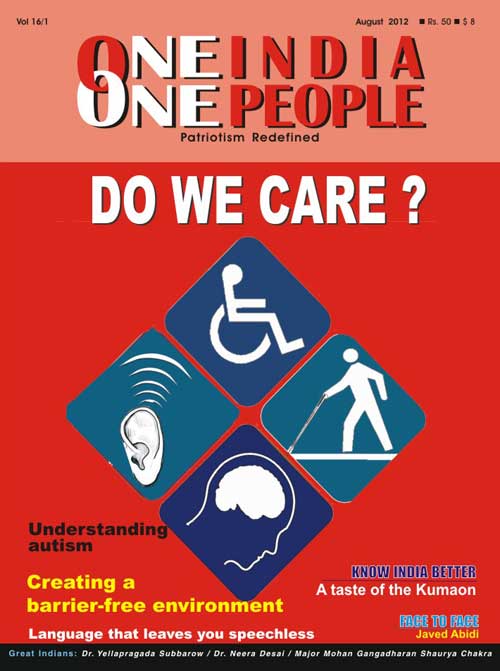
August 2012 issue ‘Do We Care?’

Disability is a condition that often evokes sympathy but not empathy. The disabled in our society are discriminated, more because of lack of awareness rather than insensitivity.  Despite a sizeable population of disabled in India, it is unfortunate that they are not on the radar screen of the Nation. It is shocking that till 1995 there was no law to secure their rights and for 54 years after Independence, till 2001, they were not counted in the census. While these two basic flaws have been corrected, the damage done was so huge that generations have paid and will pay the price for being disabled in India. Even the proposed Right of Persons with Disabilities Bill, 2011 is riddled with problems, and calls for the urgent attention of the Ministry of Social Justice to rectify the faults.

With proper education and employment opportunities, most disabled persons can do as well as any other human being in society and can play a contributing as well as fulfilling role in society. What is needed though is a change in societal attitudes towards the disabled and sensitivity towards their needs such as providing them accessible surroundings, inclusive education, employment opportunities and above all acceptance.

The August 2012 issue of One India One People looks at the various challenges faced by the disabled in India and also the various advocacy groups that are building awareness and fighting for the rights of the disabled. Awareness and a little caring attitude of citizens towards the disabled can go a long way in breaking barriers is what the issue attempts to highlight.

In the lead article on The Rights of Persons with Disabilities Bill, 2011, Rahul Cherian Jacob, founder of Inclusive Planet Centre for Disability Law and Policy, stresses the need to redraft the Bill from scratch to meet the needs of the disabled population of this country. He observes that The Persons with Disabilities (PWD) Act, 1995 is an outdated legislation and needs major amendments, while the proposed Rights of Persons with Disabilities Bill, 2011 is riddled with many problems.


In ‘Creating a barrier-free environment’, Shivani Gupta, founder of AccessAbility, India’s premier Access Consultancy firm based in New Delhi, an expert on  issues and policies relating to accessibility and recipient of several awards for her consistent inputs towards promotion of inclusive environments, writes that accessible infrastructure is one of the key requirements to enable inclusion. Infrastructure planning must include accessibility for disabled people by default and budgetary allocations must be made to retrofit accessibility into the existing infrastructure, she adds.


In ‘Channelising abilities’, Shanti Raghavan, founder and Managing Trustee of Enable India, a non profit organisation that works for the economic independence and dignity of persons with disability across India, says that persons with disabilities are neither less abled nor less efficient than others, but they fail to get employment because employers are unable to use their potential.


The article ‘Education through an inclusive lens’, looks at inclusive education. Ruma Banerjee, Director, Seva-in-Action Association, Bangalore, writes that while the RTE Act provides for inclusive education, the need of the hour is an inclusive learning environment, which provides accessible infrastructure, peer support, humane teachers and systemic reforms.


Shubhangi Vaidya is the mother of a teenager with autism and teaches in the School of Interdisciplinary and Transdisciplinary Studies, Indira Gandhi National Open University, New Delhi. In ‘Understanding autism’, Ms Vaidya says that autism is a difficult and challenging disorder to deal with, but advances in science, medicine and educational interventions can make the life of autistic persons more fulfilling, enabling them to actualise their potential.

In ‘Language that leaves you speechless’ and ‘Advocating a bold attitude’, Malay Desai, a writer with Trinayani, a not-for-profit advocacy trust founded by Ritika Sahni, tells us inspiring stories of Sunil Sahasrabudhe, a teacher and Nilesh Singit, a disability rights activist, who have overcome their disabilities to live a fulfilling life. (This is a part of a series of articles that celebrate the intriguing lives of persons with disabilities. Trinayani works towards Disability Awareness and Support, communicating through workshops/seminars, print, radio, films and other electronic media.)


In ‘The war against polio’, T Jacob John, retired professor of Clinical Virology at Christian Medical College, Vellore and who has served on the Global and National Committees on Polio Eradication, highlights some flaws and positive aspects of the National Polio Eradication Programme and concludes that there are enough reasons for India to be proud about eradicating polio.


Know India Better
In ‘A Taste of the Kumaon’, Akul Tripathi, media professional and travel writer, is enamoured by the impeccable natural beauty in the rolling hills of Kumaon in Uttarakhand and after a brush with adventure sports and a walk around a haunted lake, sets off in search of a life changing experience - to sight a tiger in the wild at the legendary Jim Corbett National Park. 
In ‘The Eden of Deccan’, Akul Tripathi treads softly around the proud blossoms of an unknown Eden, the Kaas Plateau near Satara, tucked away in the hills of the Deccan.


General section:
In ‘Advice abroad is applicable at home’, Prof. B. Ramesh Babu, a specialist in International Relations and formerly the Sir Pherozehah Mehta Professor of Civics and Politics at Mumbai University, takes a critical look at Prime Minister Dr. Manmohan Singh’s address at the global meeting on sustainable development in Rio de Janeiro, Brazil in mid-June. The address was replete with sermons to the West. However, looking at the chaos within the UPA government, Prof. Babu feels it is high time that the PM practices what he preaches.

In ‘21st Century as the Asian Century: Challenges to Indian role’, P. M. Kamath, Hon. Director, VPM’s Centre for International Studies, Mumbai and former professor of politics, University of Mumbai, notes that the biggest challenge to India emerging as a major power in Asia is lack of will power in the present Indian leadership to exercise that role.

Face to Face: “Discrimination arises more from the lack of awareness than insensitivity,” says Javed Abidi, pioneer of the cross-disability movement in India in an e-mail interview with Rajlakshmi Pillai. Abidi founded the Disabled Rights Group in 1993 to work specifically on cross-disability issues. He was instrumental in setting up the National Centre for Promotion of Employment for Disabled People (NCPEDP) in 1996 and has been its Director since 1997. Abidi talks about the challenges faced by people with disabilities in India and the need for creating awareness in society. 

This issue profiled three Great Indians:
Dr. Yellapragada Subbarow-The complete scientist (1895-1948) - The New York Herald Tribune described Dr. Yellapragada SubbaRow as “An eminent medical mind of the century.” He discovered cures for many killer diseases which brought great relief to millions of ailing people throughout the world.

Dr. Neera Desai-A pioneer of women’s studies (1925-2009) - Dr. Neera Desai was responsible for attracting hundreds of young college girls into emerging discipline called ‘Women’s Studies’. She nurtured two generations of women researchers, activists, academicians in such a way that women’s cause became a lifelong mission to them.

Major Mohan Gangadharan Shaurya Chakra-The officer with a ‘Buddha smile’ (1961-1999) - A promising officer and a gentleman to the core, Major Mohan Gangadharan, lost his life while fighting Karbi militants in Assam. He displayed conspicuous courage, exemplary leadership, devotion to duty and gallantry beyond the call of duty and was a source of inspiration to his men.

And also read our regular columns and other features. To book a copy, email to oiopfoundation@gmai.com / oiop@vsnl.net or call Nagesh Bangera, OIOP Subscription-in-charge at 022- 2353 44 00.
We look forward to your feedback.