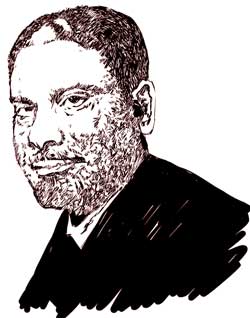
Mr Sadanand Shetty......

Mr Sadanand Shetty......
Sadanand Shetty...Founder OIOP

Tuesday, January 29, 2013


February 2013 issue
Medical ethics – Where does the buck stop?


Wikipedia describes medical ethics as a system “of moral principles that apply values and judgments to the practice of medicine. As a scholarly discipline, medical ethics encompasses its practical application in clinical settings as well as work on its history, philosophy, theology, and sociology.”
In 1955 two philosophers Thomas L. Beauchamp and James F. Childress put forward the principles of medical ethics. They identified four principles, which have become the cornerstone of medical ethics. 1. Do the best for the patient (beneficence) 2. Do no harm (non malfesance) 3. Autonomy  4. Justice.
However, with growing commercialisation and greed of medical professionals, medical ethics is a term to be referred to only in textbooks. As patients are treated as customers or guinea pigs, there is growing mistrust between doctors and patients. Regulators like Medical Council of India (MCI) and other bodies too are shrouded in controversies. So who will bell the cat?

The February 2013 issue of OIOP is on this frequently debated topic - Medical Ethics. Eminent doctors and other professionals candidly speak on the rot that has set into the system and stress upon the need for medical professionals to uphold the principles of medical ethics. We hope that the issues debated help in bringing awareness and the regulating bodies, the government and the doctors work together to rebuild the lost trust in the medical profession.

In ‘The grey areas’, Dr. G. D. Ravindran, Professor of Medicine and Medical Ethics, Head of Dept of Medicine and Medical Ethics, St. John’s Medical College, Bangalore, writes that there are no black and white solutions to ethical problems in medicine. It is a grey area through which a doctor has to wade through. Decisions made should have a solid basis on the principles of medical ethics, as he suggests how some of the road blocks can be removed and an ethical medical profession can be a reality.

In ‘Whither trust in doctor-patient relationship?’, Dr. Vijayaprasad Gopichand, community health physician, currently pursuing PhD in Public Health Ethics from the School of Public Health, SRM University, Tamil Nadu, says that good doctor-patient relationships are extremely rewarding and enriching for both the doctor and the patient. The bond can be built by communication and showing compassion towards the patient, he adds.

In ‘Ethics and law in conflict’, Dr. Lalit Kapoor, a General and GI surgeon and founder, Medico-Legal Cell, Association of Medical Consultants, Mumbai, writes that the Medical Code of Ethics is out of sync with times and the Medical Council Act is a flawed piece of legislation which needs re-crafting. He calls for a greater autonomy for the medical councils and hopes that they are kept free from political interference. Dr. Kapoor has also authored a book Better Safe than Sorry–Medico-Legal Dos and Don’ts.

In ‘The unholy trade’, Dr. Samiran Nundy and Dr. Vibha Varma, say that organ transplantation is a life saving and life enhancing procedure but is accompanied by a host of problems which involve cost, doing harm to a living donor, curbing the organ trade and deciding on an equitable and just way to distribute organs. We are still far from finding solutions to these problems.
Dr. Vibha Varma is a Consultant in the department of Surgical Gastroenterology and Liver Transplantation Department at Sir Ganga Ram Hospital.

In ‘Partners in crime’Sunita V S Bandewar, currently an independent researcher in global health and bioethics, writes that by being party to sex-selective practices, medical professionals have been contributing to strengthening cultural norms and practices that are gender discriminatory as it works against girls.

In ‘Clinical trials - shrouded in controversies’, Dr. Reba Kanungo, Dean-Research and Head of Clinical Microbiology at Pondicherry Institute of Medical Sciences, observes that clinical trials in India are raising questions on ethics. Expansion of knowledge through medical research must not lose track of the basic principles of ethics when it involves human participants, she adds. Dr. Kanungo is also the President of The Indian Association of Medical Microbiologists.

In ‘Who is a ‘next friend’, Neha Madhiwalla, coordinator of the Centre for Studies in Ethics and Rights, Mumbai, questions how an institution can be a ‘next friend’ in euthanasia cases, as she feels only a human being can produce such an altruistic response, not an institution. Madhiwalla is also the managing trustee of Chehak Trust, an organisation involved in developing community based models for education, life-skills and disability rehabilitation.

Know India Better: This issue we take our readers to the serene Meghalaya through the feature ‘In the Abode of Clouds’. Meghalaya, literally means ‘The abode of clouds’ and it does appear to be so when you see the glorious mountains bathe in the morning fog. Katie Dubey had an amazing experience exploring the exuberant state, wading through sparkling lakes, staring at alluring waterfalls, crawling through Mawsmai caves, feeling the richness of vast forests, being one with the tribal populace, admiring the beauty of the churches and wandering the streets of the busy capital town of Shillong. Katie is the author of three coffee-table books and writes for various newspapers and magazines on nature and environment.

In ‘Face to Face’, Dr. Amar Jesani speaks to Rajlakshmi Pillai about declining ethics in medical profession but hopes that with growing awareness in society regarding laws and ethics, medical professionals will make efforts to put their house in order.

 Dr. Jesani is an independent consultant, researcher and teacher in bioethics and public health. He has been researching on human rights, medical ethics and public health since three decades. He is one of the founders of the Forum for Medical Ethics Society and its journal, IJME (Indian Journal of Medical Ethics); and is presently its editor. He is also a Trustee of Anusandhan Trust, which runs CEHAT (Centre for Enquiry Into Health and Allied Themes) and CSER (The Centre for Studies in Ethics and Rights) in Mumbai and SATHI (Support for Advocacy and Training to Health Initiatives) in Pune.

General section:
In ‘India needs to stand up to China’, P. M. Kamath, currently, Director, VPM’s Centre for International Studies (Regd), Mumbai and Adjunct Professor, Department of Geopolitics and International Relations, Manipal University, opines that China in reality has gone from assertiveness to aggressiveness in its policy toward India. India, he says should regain her strength by standing up to China and assert its legitimate role in international relations. This will also win back her South Asian friends. Kamath is former Professor of Politics, University of Bombay and his book on India-China Relations for Asian Century (Gyan, 2011) deals with some issues raised in this article.

In ‘Where does your city’s garbage go?’, Disha Shetty, pursuing a post graduate diploma in Broadcast Journalism from the Asian College of Journalism, Chennai, brings you a slice of life from Kodungaiyur garbage dump yard, a part of Metropolitan Chennai. She meets children who are school dropouts and live on the waste. Her article highlights the conflict between the residents and the local municipal corporation in metros that arises due to the close proximity of dumping grounds near residential colonies which pose a health hazard to the people.

OIOP February 2013 highlights the significance of the National Science Day celebrated on February 28, each year. Arvind Gupta, a scientist and winner of the inaugural National Award for Science Popularization amongst Children in1988. emphasises the need to inculcate scientific temper in society, initiating activity based learning in schools and promoting a cost-effective science activities programme in villages and municipal schools of India. This, he says would be a lasting tribute to the vision of Sir C. V. Raman – whose work we celebrate as the National Science Day. Gupta works in IUCCA’s Children’s Science Center in Pune and shares his passion for books and toys through his popular website http://arvindguptatoys.com.

In ‘Youth Voice’ Sakshi Nanavati, who works as a Senior Executive at the Royal Bank of Scotland (Mumbai) writes on how a common culture and tradition binds Indians. Stating that an independent nation is a gift to us from ancestors, she calls upon the youth to nourish this independence to build a country that stands on the ideology of One India, One People. Sakshi is a gold medalist in MA Economics (May 2011) from SNDT University. She is a visiting faculty at ITM Institute of Management and since seven years, she has been a part of Rotaract, an international voluntary youth organisation and the youth wing of the Rotary. 

In Great Indians we feature:

Chempakaraman Pillai, The spirited and daring fighter (1891-1934);
 
Lt General Ranjit Singh Dayal PVSM, MVC, The hero of Haji Pir (1928-2012) and

Captain Keishing Clifford Vincent Nongrum MVC, The daredevil Captain (1974-1999).


And also read our regular columns and other features. To book a copy, email to oiopfoundation@gmai.com / oiop@vsnl.net or call Nagesh Bangera, OIOP Subscription-in-charge at 022- 2353 44 00.
We look forward to your feedback.

Monday, January 7, 2013

January 2013


As we enter 2013 with new hopes and aspirations, OIOP in its January issue, takes stock of some of the pertinent socio-political issues that we have been facing, and in whose solution lie answers we seek to build a better, responsible and self sustaining society. We have focused on seven burning issues – Accountability of people in power, Corruption, Delay in Justice, Basic amenities, Holistic health, Education for all and Sustainable rural development. While accountability in every sector, especially, the government, can ensure smooth governance and scale down corruption to a large extent;transparency in every organisation will definitely help minimise corruption. Experts give their valuable opinions on how with vision and will, we can summon the strength and skill required for the much needed transformation to bring good governance. Justice delayed is undoubtedly justice denied. The need of the hour is to revamp our Judiciary and help people get speedy justice. The earlier concept of basic amenities of ‘roti, kapda and makan’ is yet to see the end result, thus making it necessary to widen the concept and include the right to food, education, employment, pension and disability benefits as the very right of individuals and work towards achieving the same. Health is another factor that requires immediate attention. Each one of us should make healthy lifestyle choices and focus on holistic health where the mind, body and spirit in equilibrium. Education is also an issue which needs to be looked at, in a broader perspective. RTE Act brings big hopes but only if the government stops interfering and allows the schools to function smoothly.
So let our New Year's resolution be to collectively work to bring the change in society, that we wish to see. Citizens need to be proactive in nation building. Only then can we hope for a corruption free, accountable, just and healthy society, where there is speedy justice, education for all, right to live a better and dignified life and sustainable villages. With this thought, we wish our readers a very Happy New Year!

Highlights of January 2013 issue ‘Looking back, Looking forward’

Lack of accountability, unbridled corruption in certain sectors, bad governance and rising discontent are undermining our republic. In the lead article ‘Enforcing Accountability’, Dr. Jayaprakash Narayan, the founder and President of Lok Satta Party, suggests solutions that can check abuse of power and usher in a more responsible and accountable system of governance.

Systematic and continuous propagation of introducing greater transparency in every organisation can minimise corruption. In ‘Still a long way for corruption to go’, N. Vittal, former Central Vigilance Commissioner, says that though the progress in weeding out corruption in a democracy is slow and frustrating, one must not lose hope.

In ‘Revamp system for speedy justice’, Krrishan Singhania, Dr. Olav Albuquerque and Madhur Kabra urge for revamping the entire system of criminal and civil jurisprudence which India has inherited from the British. Krrishan Singhania heads the Mumbai office of Singhania & Co, an all-service law firm in Mumbai which specialises in various infrastructure sectors such as aviation, shipping, power and telecom. Dr. Olav Albuquerque is a Senior Associate lawyer while Madhur Kabra is Associate lawyer in the same firm.

The earlier mantra of ‘roti, kapda and makaan’ has failed to cultivate a strong human capital resource and employ it, and secure its old age and vigour, writes Anuradha Kalhan, Lecturer, Dept of Economics, Jai Hind College, Mumbai, in ‘Five shades of grey today’, as she presses for a broader list of basic amenities to include the right to food, education, employment, pension and disability benefits.

Rather than being overwhelmed by all the available research and advice, people should take charge of their own health by making healthy lifestyle choices. In ‘A holistic way to health’, Dr. Rachna Khanna Singh, a Holistic Consultant & Lifestyle Management Expert, opines that the need of the hour is to focus on holistic health that emphasises the connection between mind, body and spirit.

The RTE Act is a right step in ensuring quality education to children but only if the government stops enforcing absurd norms and conditions on schools. It is time that the government only acts as facilitator and creates conducive atmosphere for education sector to function smoothly, writes Shantanu Gupta, Associate Director, School Choice Campaign, Center for Civil Society, in Let schools be’.

In ‘A sustainable model for rural development’, Srijan Pal Singh says that the new generation model of rural development has to cover multiple dimensions of sustainability which should include financial, ecological, social and cultural sustainability as well as being upwardly mobile and on the right track of the learning curve. The writer is an author, columnist and expert in Sustainable Development. He worked with Dr. APJ Abdul Kalam towards the evolution of the development system of PURA (Providing Urban Amenities in Rural Areas) and has co-authored the bestseller on poverty alleviation – Target 3 Billion.

In ‘Know India Better’, we feature ‘A Borderless Subcontinent’. Akul Tripathi, a media professional and freelance writer, tells of his travels by roads to the borders of India, those he intends to make and others he prays will be possible in his lifetime.

“Undoubtedly, Nehru was India’s best PM,” says Kamal Morarka, former union minister and Rajya Sabha MP in an interview with Lina Mathias, senior assistant editor, Economic and Political Weekly, where he talks about governance, governments and Parliament. Morarka is a successful industrialist, a convinced socialist, a wildlife photography enthusiast and voracious reader. He leads the Samajwadi Janata Party (Rashtriya) besides chairing non-governmental organisations (NGOs) that work in the fields of wildlife research and conservation, rural development, health and arts and crafts. 

In our general section, P. M. Kamath, formerly Professor of Politics, University of Mumbai, in his articleAjmal Kasab and Imran Khan’, questions the logic in Imran Khan’s demand for executing Sarabjit Singh, soon after the hanging of terrorist Ajmal Kasab, as  the two cases cannot be equated.

Starting with this January issue, OIOP will carry an article commemorating national days. We begin with the Army Day that is celebrated on January 15th. On this occasion, OIOP joins Brig S C Sharma (retd.) in paying tribute to the remarkable, ever alert and brave ‘Indian Soldier’.

In ‘My Transformation Transforms Nation’, Swami Swatmananda, President, Chinmaya Mission, Mumbai, explains how  transforming India can be a reality with each individual transformation - which is a self-motivated initiative to be taken.

In Youth Voice aimed at encouraging our youth to express their concerns and opinions on various issues, Lakshmi Raman, who is studying criminal justice at the Rochester Institute of Technology in the US, candidly speaks about her journey towards “self acceptance” in ‘Defining beauty’.

Great Indians features:
Pandit Ravi Shankar (1920-2012) – one of the tallest musicians produces by the country and culture; 

Thakorbhai Shah (1928-2004), veteran trade union leader and social activist; 

Lt Navdeep Singh AC (1988-2011), a brave solider who made the supreme sacrifice so that the Tricolour should continue to fly over the Gurais heights in Kashmir.

In addition, read our regular columns, features, snippets, satire and more!
To subscribe, write to Nagesh Bangera at oiopfoundation@gmail.com,oiop@vsnl.net or call – 022-2353 44 00

Monday, December 10, 2012


December 2012

The recent arrest of two young girls from Palghar in Thane district for their remarks on their Facebook account, draws attention to the issue of Freedom of Expression in our country. This is not the first time that someone’s right to express has been challenged. Writers and artists in India have faced flak and threats in the past from fundamentalist forces for alleged ‘misrepresentation or misguidance or inciting religious sentiments.’ A proper definition as to what comes under these terms is still to be deciphered. Yet, writers, journalists, artists and historians have been targeted time and again by the so called moral police. The new add-on to the list is the popular social media. Certain things and certain people are a taboo and they cannot be written about, is the unwritten rule. Those who follow the rule can lead a peaceful life but those who challenge it, will have to face the wrath of hooligans who take law into their own hands and go about destroying property and indulge in physical violence with scant respect to law of the land. While it is expected that citizens show tolerance, it is also necessary to analyse how we are going to use the Freedom of Expression that the Constitution of India has bestowed on us. It is true that none of us appreciate censorship in our life, at the same time, it is imperative that we also use the right responsibly and wisely. In the hope that the pen, the brush and the mouse click are free to move as they would like to, albeit responsibly, the December issue of OIOP debates on the citizen’s ‘Right to Express’

In the lead article ‘Where the mind is without fear…’, Ranjona Banerji, senior journalist and consulting editor with the media website MxMIndia.com, writes that fear of possible reprisal at every step and indiscriminate banning of art or literature or attempts to curb the media are hardly hallmarks of a mature democracy.

In ‘Tolerance is the key’, Mihir Desai, human rights lawyer in Bombay High Court, writes that while the Courts have generally upheld freedom of speech and expression the State and the fringe fundamentalist groups are becoming more and more intolerant. In the times to come we are likely to witness a heightened tension on this issue, he warns.

‘The right to write’ is on the curb of freedom faced by writers. Writers or artists may not have any special need for freedom though it is their freedom to dream and to imagine to which we owe the greatest debt. Even the totalitarian societies, the non-democratic societies, the theocratic societies need to understand this: that to be free is to be human, asserts Jerry Pinto, a writer who lives and works in Mumbai. He has won the National Award for the Best Book on Cinema. Em and the Big Hoom (Aleph) is his first novel.

‘Cinema in shackles’ focuses on threats faced by film makers in the name of censorship and moral policing. Art needs society to flourish and society needs art to change, to grow. Art forms like cinema only mirror the social change happening in society. Encouragement of the medium will usher in a more evolved society but stifling it under the guise of ‘protecting Indian culture’ will only do more harm than good, says Dr. Narendra Panjwani, the author of a recent book on Hindi films - EMOTION PICTURES - Cinematic Journeys into the Indian Self. He teaches film studies at St. Xavier’s College, Mumbai, and is Director, G D Parekh Centre for Educational Research, Mumbai University.

In ‘Freedom of the press – the threat within’, Vidyadhar Date, senior journalist, says that a much bigger threat to media freedom comes from within, from the owners who are big businessmen or capitalists and adds that today, people in media are twisting ethics and their pen for the extra pie.

‘Art cannot flourish in a stifling atmosphere’ stresses Prakash Bal Joshi, Mumbai based journalist and artist and writes that an atmosphere of tolerance based on free exchange of views and debate alone can ensure real artistic freedom. Threats or stringent laws can only harm it more.

‘The theatre’s (in)ability to resist censorship’ delves on, as the name suggests, on moral policing against theatre. The theatre seems to be a historic object of censorship of all kinds. It may be that the vigour of the attacks is related to the fact that, in the final analysis, the theatre is the most resistant to censorship medium, observes Ramu Ramanathan, Mumbai-based playwright and director. A collection of his plays, 3 Sakina Manzil and Other Plays was published in 2011.

‘We all are seditious’, says Kamayani Bali Mahabal, an expert in gender, health and human rights issues, as she calls for revoking of all the draconian laws in the country that are anti-people and instruments towards declaring an “undeclared emergency”.

Are we willing to fight for what we are?’, asks Harish Iyer as he notes that the voices from the closets may not be loud to the outside world, but within they echo to tremor the conscience and the very being of the human being because we curb the freedom to be different, and unique. Harish is an active voice for Child Sexual Abuse and Equal Rights for Women and the LGBT among an ensemble of other causes. He is in his early 30s and his life has inspired a biography and 2 critically acclaimed films - national award winning I AM and Amen, which was released recently on DVD (www.bit.ly/AMENdvd). He blogs at www.hiyer.net and tweets as @hiyer.

In ‘Moral policing – the new demon’, Sunil Prabhakar, a well-known expert on consumer issues, wonders on what basis can the moral police attack common citizens in the name of ‘protecting Indian culture’.

In ‘The Internet censorship saga in India’, Shobha SV gives an account of the internet censorship in India and the efforts of various netizens to resist it. (Article courtesy: www.internetdemocracy.in)

The ‘Know India Better’ feature is on ‘Lucknow: City with a glorious past’. Spread out on both sides of the River Gomti, Lucknow, once known as the city of Nawabs, is famous for its charming culture as much as it is for its magnificent monuments like the Bara and Chhota Imambara and Rumi Darwaza. Music, poetry, dance and literature flourished in the 18th century under the royal patronage of the Nawabs. Though the city is keeping pace with modern times, it still retains the famed courtly manners of aadaab and tehjeeb. Text and photographs are by Dr. M.A. Haque, retired Advisor, Ministry of Environment & Forests, Govt. of India.

In ‘Face to Face’, Rangasamy Elango, Scientist, Panchayat leader, social worker and an inventor, speaks to Disha Shetty, pursuing a PG Diploma in Broadcast Journalism from the Asian Journalism College, Chennai, about his efforts to divert attention to the two major crises in Indian villages - power and sanitation. Hailing from a socially oppressed caste he fought his way up to be an engineer and hold a government job as a scientist at the Central Electrochemical Research Institute. He later quit his job to become a panchayat leader in 1996 and has since focused his energy on developmental work in his village. As the force behind making his village Kuthambakkam that lies to the north of Chennai, a model town, he shares how communities can transform themselves. Elango is the recipient of ‘the One India One People Outstanding Indian Award’ in 2009. Disha is pursuing a post graduate diploma in Broadcast Journalism from the Asian College of Journalism, Chennai.

In ‘Great Indians’, we feature:

Brig Rajinder Singh MVC, The saviour of Kashmir (1899-1947) – His heroic stand at Uri and rearguard action from Uri to Baramulla saved Kashmir and the honour of the country when everything hung by a slender thread.

Comrade Vasant Gupte, Champion of the unorganized (1927 – 2010) – He was one of the first trade unionists to extend training to workers, in law and negotiations.  He made the workers capable of handling their problems themselves and taking their own decisions.

Squadron Leader Ajay Ahuja Vr C, Truly a fighter (1963-1999) - The brave officer died when his aero plane was hit by a Pakistan missile. Squadron Leader Ahuja was on Kargil duty and was on a search to locate his brother officer Flt Lt Nachiketa.


In addition, read our regular columns, features, snippets, satire and more!
To subscribe, write to Nagesh Bangera at oiopfoundation@gmail.com,oiop@vsnl.net or call – 022-2353 44 00

Tuesday, November 13, 2012

November 2012 issue


Gender Tilt
The last few decades have seen Indian women do exceedingly well for themselves in all walks of life. However, gender discrimination at home and workplace continue to exist despite the progress that we have made as a nation. Education and laws have not yet been able to bring the desired social change. Women are still battling issues such as female foeticide, sexual harassment, molestation, equality, domestic violence, regressive customs and attitudes, safety in public places, etc., all of which call for change in mindsets of people. While in urban areas, the awareness is greater and we can see a small change happening, it will be long before the change trickles down to villages. We have a number of laws to protect women from atrocities in society, but we need stricter implementation of these laws for a visible change. Gender sensitization of boys from an early age and making it mandatory for girls to learn martial arts in schools are two solutions that can probably tilt the bias in favour of women.

The November 2012 issue of One India One People looks into the gender bias prevalent in Indian society. Eminent women activists and researchers highlight the bias against women and offer solutions for social transformation.

The lead article ‘An unfair tilt’, as the title suggests focuses on gender discrimination. Ranjona Banerji, senior journalist and currently a consulting editor with the media website MxMIndia.com, writes that as long as institutions like the police and courts are ‘manned’ by those who find equal rights for women difficult to accept, gender discrimination in society will continue.

Crime of any kind flourishes when the perpetrators do not fear punishment or social ostracism. A look at the desultory police investigations into crimes against women and the resultant abysmal conviction rates brings home this point, writes Lina Mathias, senior assistant editor, Economic and Political Weekly in ‘Iron fist, not velvet gloves’, in her article on the safety of women in public places, where she stresses that perpetrators of sexual harassment should not be allowed to get away unpunished.

The article ‘A new millennium, but old rules’ by Prof. Namrata R Ganneri, Assistant Professor, Department of History, SNDT College of Arts & SCB College of Commerce & Science for Women, Mumbai, points out that despite a slew of legislations protecting women against injustice, many regressive customs still persist in India, which present a fundamental dilemma about the survival of young women in the new millennium.

Working enhances a woman’s world view and her sense of self-worth. But her status as a professional is neither given enough credence nor due recognition. In that sense we haven’t moved very far from the time when women were asked to bake the bread brought in by the breadwinner, writes Amita Sahaya in the article Breadwinner or just the baker? The writer is the Founder Secretary of the non-profit organisation Women Work & Health Initiative (WWHI) and has been working as a social entrepreneur with focus on the field of gender for several decades.

‘Laws cannot change mindsets’, note lawyers Krrishan Singhania, Dr. Olav Albuquerque and Madhur Kabra of Singhania & Co, an all-service law firm in Mumbai which specialises in various infrastructure sectors such as aviation, shipping, power and telecom. According to them it is not just laws but change in mindsets that will bring the desired social change.

In the article, ‘Dual torture for Dalit women’, Dr. Kranti Gawali, observes that atrocities against Dalit women stem from two factors—gender bias within the family and caste bias within the society. A change in mindset and the deep-rooted patriarchal system may reduce crime against Dalit women, she concludes. Dr. Gawali is clinical psychologist, and is Head of the Department of Psychology at Bhavan’s College in (Andheri). She also works as a counsellor for a NGO working for women in distress, and is an activist for the issues of Dalit Women.

Women and men must join hands to confront social barriers and ensure justice and equality. In ‘Breaking social barriers, together’, Dr. Vibhuti Patel writes that lessons in gender sensitization should start early in life as they go a long way in bringing about social transformation and encouraging gender responsive behaviour and mindsets. The writer is Professor and Head of Economics Department of SNDT Women’s University, Mumbai.
‘Migrant India’s brave new daughters’ is a feature on how migration has empowered many rural women and provided them the freedom to do things their way and live a new life for themselves in the urban setting. A WFS (Women’s Feature Service) feature by Preet Rustagi, Professor and Joint Director, Institute for Human Development (IHD), New Delhi.


‘Look who’s wearing the pagdi’ by Abha Sharma (WFS), features a family in Beechdi village in feudalistic Rajasthan, which has reversed traditions by tying the ‘pagdi’, usually associated with male pride and honour, to the eldest daughter and anointing her as the heir to the family. The daughter also performed her father’s last rites.

This month, we feature Kashmir, the Snow Paradise, in ‘Know India Better’. All seasons in Kashmir have a unique charm but winter especially is an experience out of the world. Rangan Datta, an avid traveller and travel writer, had some enchanting moments in the snow, lush green meadows and exploring the floating gardens and markets in the Dal Lake in a shikara.

In ‘Face to Face’, Jyoti Mhapsekar, President of the Stree Mukti Sanghatana (Women’s Liberation Organisation) and one of its founding members, speaks to Rajlakshmi Pillai, on various issues concerning women’s emancipation and her Sanghatana’s fight against gender bias. Mhapsekar is also a playwright and song writer, whose play Mulgi Zhali Ho (A girl is born), a satire showing gender bias in society, is still very popular. 


Great Indians:

General Zorawar Singh, the saint soldier (1786-1841), was the most gifted soldier of India in the 19th century.


Dr. Pramod K. Sethi, the man behind Jaipur Foot (1927-2008), whose invention has enabled many disabled to stand on their own.


Air Marshal Aspy Merwan Engineer DFC, the unsung IAF hero (1912-2002), who rendered distinguished service in the Indian Air Force.


In addition, read our regular columns, features, snippets, satire and more!
To subscribe, write to Nagesh Bangera at oiopfoundation@gmail.com, oiop@vsnl.net or call – 022-2353 44 00